Be yourself; Everyone else is already taken.
— Oscar Wilde.
This is the first post on my new blog. I’m just getting this new blog going, so stay tuned for more. Subscribe below to get notified when I post new updates.
Be yourself; Everyone else is already taken.
— Oscar Wilde.
This is the first post on my new blog. I’m just getting this new blog going, so stay tuned for more. Subscribe below to get notified when I post new updates.
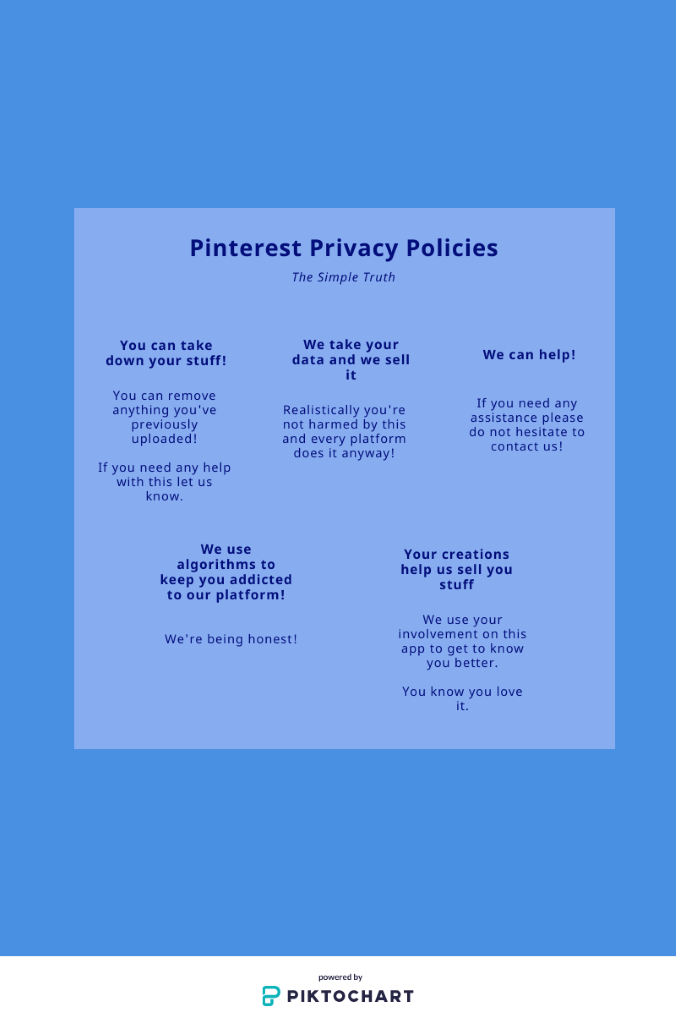
I personally have never read a privacy policy for any social media platform that I’m part of. I also don’t know of anyone my age who read them either. I think part of this is because they’re way too long and are not visually attractive. There’s also the mentality that you’re going to end up joining the platform regardless of the policies so what the point in reading them? Alongside this, even if there are negative consequences, everyone else is already using the platform and so if we’re all subject to these policies what’s the harm? Because of this reality, I chose to keep my privacy policies very short, visually attractive and brutally honest. I used Andersons policies.
References:
Anderson, J. (2017). A lawyer rewrote Instagram’s privacy policy so kids and parents can have a meaningful talk about privacy. Fine Print. Retrieved fromhttps://qz.com/878790/a-lawyer-rewrote-instagrams-terms-of-service-for-kids-now-you-can-understand-all-of-the-private-data-you-and-your-teen-are-giving-up-to-social-media
In this module I was introduced to social media in a way that I had never experienced before. Some prior knowledge that helped me was my general involvement with social media. I’ve grown up with it as a part of my everyday life. I found this module to be a building block on top of this foundation, exposing to me new perspectives and analyses of platforms I’ve been familiar with for years.
In the beginning, we learnt about the various methods of communicating on social media. We discussed the area of micro-influencers and the power they have. I found this week extremely interesting as I’ve been surrounded by influencers for years, constantly seeing them on my phone. I hadn’t however, acknowledged the real power that these people have on me and the way in which they shape my consumer habits and those of my peers too.
We then discussed the management of information online, and the pros & cons of users being able to create public content online. An interesting case study showing some dangerous effects of user contribution was that done by Guidry, J.PD., Carlyle, K., Messner M. & Jin.Y (2015) on the impact social media had on whether or not children were receiving vaccines. They address the habit of people using the internet to learn about health issues. They noticed, however, that the majority of the discussions on social media were being had by normal citizens who lacked medical training. Their anti-vaccine messages were filled with emotive language as opposed to medical research. Guidry, J.PD., Carlyle, K., Messner M. & Jin.Y (2015) highlights the importance of health professionals being aware of this and suggests that they also participate in these online spaces. I found this piece intriguing as I had never considered that user contribution could result in such significant consequences.
We then looked at how social media can be used to communicate information in creative ways. I enjoyed learning about this aspect as I can see how this knowledge could be incredibly applicable in a future job. Whether for marketing, pitching ideas or communicating with colleagues, this is a crucial field to be aware of. I was grateful for this learning experience as I see the benefit of using this knowledge in my future studies. Part of my degree is Social Justice. In this field there is large importance in making others aware of issues that are occurring. It’s very common for people to not be educated on topics of injustice as they’re often so far removed from the issues resulting in them being unrelatable. Displaying information in creative ways could encourage the public to understand these issues, allowing them to engage with the information and potentially help others.
We then explored the use of video and audio in order to connect and communicate with others. Bongo helped a lot throughout this module. I often struggle with how you don’t get to see the work your fellow students are producing. It leaves me feeling anxious and confused as to whether or not I’m doing a task correctly. I loved listening to what others had learnt, hearing how different people pick up on different aspects of lessons. I found that combining various perspectives of learning resulted in me collecting a wider field of new knowledge; more than I would have retrieved alone. I found receiving and giving feedback to be a valuable element of the software. It allowed me to communicate with students, giving me the opportunity to give them praise but also make suggestions on how to improve. I enjoyed getting feedback because it encouraged me in my work. Some specific comments I got were that my work was “concise and informative,” another saying, “nice and short, a different perspective to others.” This was helpful as it told me I was writing enough and that keeping it short was effective. It also helped me to realise that if I said something different to another peer, I hadn’t got it wrong, I had just seen it in a different way which can in fact be a valuable thing. This last realisation is one I’ll hold with me throughout the rest of my life; understanding that it’s okay to get different answers from those around you.
Next, I learnt about how social media can be used for our learning at university. Ridley, D. gives 3 different ways that social media can be used in universities. Firstly, it can attract potential new students. As people share their experiences online through pictures and videos, a realistic depiction of what the college is like can be created. Secondly, students are able to share their experiences through blogs, hashtags and more, allowing a connection with other students. Thirdly, social media provides a platform for students to receive answers regarding issues they’re having. Ridley, D. gives the example that student services are often available all through the night, equipping them with the tools and support that they need.
One of the areas I found most interesting to learn about was the ethics of social media. Cohn, C. explains etiquette as the “code of behavior within the context of our society.” She discusses how social media is a community where we must learn to navigate our way respectfully. I valued this learning experience as it related to the social justice aspect of my course and is crucial to consider when discussing the place social media platforms have in our lives. This area made me consider potential future challenges. As social media develops, people get more comfortable with sharing deeper, more vulnerable parts of their lives. Considering the ethics of privacy and the exploitation of user data will be a crucial area to be aware of.
We then learnt about the presence of emotional information on social media platforms. Pennington, D. R. (2015) talks about how participatory culture can be used to further develop how we find our desired content. She defines participatory culture as “a range of different groups deploying media production and distribution to serve their collective interests.” Understanding the emotional responses people have to creative content could allow a system where specific emotions could be used as a search filter. I found this to be a unique approach to how social media platform could be developed.
Reaching the end of the module we looked at social media trends. This again fascinated me, in a similar way to the influencer topic. Trends on social media are something I’ve witnessed for years; I’d almost argue they’re part of my culture. For me, reading a piece by Duty on how to foresee, analyse and create trends was amusing. She claims that “You need to be steeped in social activity yourself to really know it in and out before you can spot trends.” Most young people, including myself don’t try to see/ foresee trends in social media, we naturally do as we grew up immersed in this environment. But this allowed me to see the tactics businesses use in order to relate integrate themselves into the culture that is social media.
To conclude, I thoroughly enjoyed reflecting on how social media is relevant to all aspects of our lives. I plan to bring these many lessons along with me throughout the rest of my studies and look forward to seeing what ways social media will develop and integrate itself into our future.
References:
Guidry, J.PD., Carlyle, K., Messner M. & Jin.Y (2015). On pins and needles: How vaccines are portrayed on Pinterest, Vaccine, 33, 5051- 5056. https://doi.org/10.1016/j.vaccine.2015.08.064
Ridley, D. How Today’s Colleges and Universities are Using Social Media (n.d.). Vital, retrieved from https://vtldesign.com/digital-marketing/social-media/how-todays-colleges-and-universities-are-using-social-media/
Cohn, C. (n.d.). Social Media Ethics and Etiquette, Compukol. Retrieved fromhttps://www.compukol.com/social-media-ethics-and-etiquette/
Pennington, D. R. (2016). The most passionate cover I’ve seen”: emotional information in fan-created U2 music videos. Journal of Documentation. Vol. 72 Iss 3 pp. 569 – 590 DOI: 10.1108/JD-07-2015-0086
Duty, L. (n.d.). How to Identify Social Media Trends Before Anyone Else, Rocksdigital. Retreived from: https://www.rocksdigital.com/identify-social-media-trends-everyone-else/
This week’s task included creating our own privacy policy for a social media platform. I found this task quite difficult at first because I had no prior knowledge of the topic and honestly found it really boring. From reading the 5 rights mentioned by Anderson (2017), I realised that privacy is such a crucial area of social media and that because people my age find it boring, there is a large amount of value in rethinking and reshaping how privacy policies are communicated.
From creating my LinkedIn profile I’ve realised the amazing benefit social media can have on my life in terms of portraying myself to others. It made me aware of how I can take control of my digital footprint in a positive way. McGuinness, C. (2016) defines your digital footprint as the “digital emissions you leave behind in this online world.” I had only considered this idea in terms of companies having access to your social media pages such as Facebook or Instagram. I really valued being able to consider this idea in light of how I can portray myself to potential employers. Having the control to choose what specific skills I link to myself gives me an amazing opportunity to present my best qualities to others online.
References:
Fulton, C., & McGuinness, C. (2016). Digital detectives : Solving information dilemmas in an online world. Retrieved from https://ebookcentral.proquest.com
Anderson, J. (2017). A lawyer rewrote Instagram’s privacy policy so kids and parents can have a meaningful talk about privacy. Fine Print. Retrieved fromhttps://qz.com/878790/a-lawyer-rewrote-instagrams-terms-of-service-for-kids-now-you-can-understand-all-of-the-private-data-you-and-your-teen-are-giving-up-to-social-media
For this week’s badge, I first downloaded the software for screen casting. I then set up the software so that it would capture the entire screen. I began recording and typed ‘UCD’ into the search bar. When it loaded, I clicked on images and then finished my recording. After this, I uploaded my video to my Youtube channel, giving it the title ‘How to search Google for images.’
I enjoyed doing this task as it gave me an insight into how simple it is to create a visual tutorial to share online. Making a Youtube video seemed like a strenuous task in my head as I didn’t know how to do it before. From carrying out this assignment, however, I’ve realised that this is a very beneficial online tool and I’m glad I gained such a beneficial skill.
This task was extremely effective. Many people find the online world difficult to navigate and often aren’t aware of how to carry out simple tasks. By using a Screen casting and Youtube, you’re able to visualise information and pass it on to others who may need it. By creating a video tutorial that is identical to the viewer’s browser, it’s a very effective way to teach somebody a new skill online.
From doing this task, I will now search video tutorials on Youtube when I need to learn something and will also consider making more myself in an attempt to help others understand the online world.
This is a link to my video tutorial: https://www.youtube.com/watch?v=Flpr9CQTy_I
Ciara Shaw – 18423936
For this week’s activities, I began by creating an account on Pocket. I then chose 3 different articles to save on my page: all about managing information online. I liked this tool because it’s a helpful platform for bookmarking articles that you intend to read. I used to feel overwhelmed with how many articles there are to read relating to my studies but in the future, I will organise them on Pocket.
I then moved on to Pinterest. I created boards and saved some pins on there. I had heard of Pinterest before but never considered it alongside my studies before. If I had known I could save information to help with my assignments on Pinterest before, I would have done so as the visual element holds my attention longer.
The third site I used this week was Google Maps. I learnt how to create a map which I had never done before. I found this task difficult at first but once I understood it, I found it very interesting as I didn’t realise you could add multiple layers of data to a map you’re creating. I can’t think of anytime that I’ll need to create a map for my studies, but I’m glad I now know how just in case!
Map Link: https://drive.google.com/open?id=1Jg1NTlGGksVyZ5z1S0tZwnBh8WKLdwxI&usp=sharing
The first task was to write a blog post. I found this to be an easy task to complete. I think this blog is a helpful tool to track my college work and analyse the methods I use for leaning. I also think I could use the blog to influence others. Wessel (2018) argues that people value “influencers who are real, genuine and relatable.” I’m an average student and I feel as though other students would care about what I have to say. I feel as though the blog would give me space to be creative in how I discuss things. Casaló et al. (2018) gives a conclusion from his studies that the key to being an influencer is being unique and artistic; qualities I think I have.
I then made a video explaining what I learnt from these tasks. I gave feedback on other student’s videos. I found this to be a beneficial. Both giving and receiving peer reviews is helpful as it gives a fresh perspective to your work with constructive criticism. An element of the software I don’t like is the aspect of videoing/recording myself. I’d rather not share a video of myself to others in the class. I think many students would relate to this and therefore it should be considered if the programme was to be brought in across campus.
Wessel, K. (2018, October 26) Why You Shouldn’t Ignore Micro-Influencers, And How To Partner With Them. Forbes. Retrieved from https://www.forbes.com/sites/forbescommunicationscouncil/2018/10/26/why-you-shouldnt-ignore-micro-influencers-and-how-to-partner-with-them/#5a4ced813ecc
Casaló, L. V., Flavián, C., & Ibáñez-Sánchez, S. (2018). Influencers on instagram: Antecedents and consequences of opinion leadership. Journal of Business Research, doi:10.1016/j.jbusres.2018.07.005
We had a class with guest speaker, Marta Bustillo. She taught us about academic writing and how to critically evaluate sources. We learnt about the process a written piece goes through to become an academic piece of writing. I also learned specific steps to take in order to determine whether a piece of writing is credible.
This is an example post, originally published as part of Blogging University. Enroll in one of our ten programs, and start your blog right.
You’re going to publish a post today. Don’t worry about how your blog looks. Don’t worry if you haven’t given it a name yet, or you’re feeling overwhelmed. Just click the “New Post” button, and tell us why you’re here.
Why do this?
The post can be short or long, a personal intro to your life or a bloggy mission statement, a manifesto for the future or a simple outline of your the types of things you hope to publish.
To help you get started, here are a few questions:
You’re not locked into any of this; one of the wonderful things about blogs is how they constantly evolve as we learn, grow, and interact with one another — but it’s good to know where and why you started, and articulating your goals may just give you a few other post ideas.
Can’t think how to get started? Just write the first thing that pops into your head. Anne Lamott, author of a book on writing we love, says that you need to give yourself permission to write a “crappy first draft”. Anne makes a great point — just start writing, and worry about editing it later.
When you’re ready to publish, give your post three to five tags that describe your blog’s focus — writing, photography, fiction, parenting, food, cars, movies, sports, whatever. These tags will help others who care about your topics find you in the Reader. Make sure one of the tags is “zerotohero,” so other new bloggers can find you, too.

